
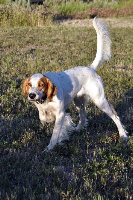
First off is the age to srart. I've never given that much though as I don't start what many concider actual training until the dog is at least a year old. Prior to that is introducing the the field where the pup discover's the life it is to lead. It is allowed to investigate at will what ever it want's and get rid of any booger's it may have. Early on, about 12 wks I also introduce the gun to the pup while letting it do as it will, another subject but, will say this. The vast number of problem's associated with gun fire are man made. While the pup is growing, it incounter's "bleep" bird's, butter fly's ect that hopefull it will chase. some people discourage the chasing of "bleep" bird's because that's not what they want but to the pup it is something to chase which incourages the hunting instinct. It will probally never catch one and later on YOU will show it how to catch a bird.
The first year is spent bringing the pup under some control also without forcing the issue. The here command is easier to teach a pup that depends on you than it is an older dog that has it's confidence built. Heel sit and other commands making it socially acceptable. I do not teach whoa until after it's started on the bird's I want it to hunt for.
So I guess for myself, force retrieving doesn't get started befor one year.
The first dog's I did were on this make shift table that was next to a wall where I could tie up a dog, it wasn't mine but belonged to a kennel I was working at. I don't think it was a good set up at all. Nor do I believe you can do a good job on the ground. One thing I noticed about many people that tried it was that their dog already retrieved but they felt they would gain something with it, I believe they were wrong. If you have a dog retrieving and it's not coming back the way you want, the problem is not retrieving, it's the "here" command. If the dog is retrieving but not giving up the bird well it's again not retrieving but the "release" that's the problem. If the dog is hard mouth, force retrieving can fix it but it's still not a retrieving problem, it's a man made problem usually induced by struggling with the dog for the bird.
The table properly used never let's these problem's come up in the first place because everything you want the dog to do is required, not asked. It is also not a brutal program done properly but a program where only the force required to get the desired result is applied. You don't start out by inducing any pain, you put the buck in the dog's mouth gently and hold it there until you take it away. First step is to teach the dog to hold the buck. The buck should also be large enough in diameter that the dog can hold it well but not so large that it might be uncomfortable and the buck should be placed just behind the canine teeth. Dog's don't chew with them and if the buck is to far back, it's in an uncomfortable spot to hold because it force's the dog to hold it's mouth open somewhat. Once the dog is holding, and not one sec sooner, the buck without your help, you introduce the pinch. Not all at once either, gradually until the dog start's to open it's mouth to yelp. The buck is then placed immediately in the mouth, pressure released and the buck held there until you reach a point where the dog will grab and hold it on it's own.
There's hole's in what I'm saying because I'm not trying to teach anyone how to do this, just explain a bit of what it is.
The table is very important, in my opinion, because it take the dog's feet away from it and elevates the dog, put's it at a comfortable level to work with the dog and it control's head movement to a degree.
For a number of years my table has been used as a work bench so please excuse the mess on it. I cleaned off much of the ,,,,,stuff!

Stay tuned, I hit the wrong button!
The table is 30" off the floor. At that hight I can stand a dog and not have to reach to much up or down to work with the dog. It is 24" wide which restrict's the side movement the dog can make befor the edge and keep's it centered where it's convient for me to work. Above the table top is a taunt cable that is a runner for having the dog move the length of the table to retrieve, the table is 8' long. The cable is 38" above the table, a height that has allowed me to work with fairly tall dogs and 2" above the cable is a 2x4 which keeps the cable taunt and contains an eye bolt for the starting process when I want the dog to be still.
In the next photo you'll see the eye bolt with the short adjuatable lead hooked up. This is where the training start's. It hohds the dog's head up and doesn't allow a lot of ducking and dodgeing. The dog is NOT strung up here, it's simply confined in a position to make the process easier for me and the dog. In the background is a pencil sharpener!


One more photo concerning the table. This the position where the short adjustable lead goes when I reach the point where I want the dog to start taking step's forward to get the buck. The snap is simply removed from the eye bolt and snaped on the cable, the lead adjusted as needed.

As I said, there's a lot of hole's here as my purpose is not to teach anyone to force train. But also I don't think an effective job can be done without a good table to put the dog at a comfortable height to work with and to gain control of the dog. For many if not most people this is not necessary. for other's that already have a dog retrieving properly, it's a waste of time as the problem is probally not retrieveing but recall or release. For my own dog's I used it on all of them because for me it's a requirement that the dog must do right every time and eliminate's the early game playing stage. It is not brutal unless some hamhanded moron decides to either push a dog to fast, loses his temper or think's he's teaching the dog a lesson. Usually a lesson that was never taught properly in the first place.
Most all dog's go down a bit when they go thru this but they come back up in the end and seem to be more confident retriever's , to me any way. And another beauty of the method is that, unlike play training, the dog never learn's it can tell you no! It alway's obey's.