
I recently fenced in a six acre area behind my house to be used for training. This area was formerly cattle pasture and has very thick stands of fescue with some sage grass. I live in Southern-Middle TN.
I trained through October, November, and some of December with great results. My young/inexperienced dogs had no trouble finding and staunchly pointing the birds. Recently, after several hard frosts, my dogs began having trouble locating the birds and their confidence and staunchness began to suffer. The birds were also harder to produce...the birds seemed to bury themselves in the thick grass forcing several relocations before the bird could be flushed.
I have seen this same behaviour with experienced dogs on wild birds in thick fescue. It seems to be worse after hard frosts where some of the grass dies and "sours". In fact, my proven dog exhibits the same behaviour to a lesser degree.
My question is as follows: What is the best perscription for my training grounds that will make for easier to flush birds? Suggestions have been to bush-hog, spray, or disk leaving narrow cover strips. Any advice on grasses or legumes that I can re-seed in these areas? Any insight on this would be appreciated...
In general, what is the best cover and conditions that I can hope for when working with young dogs that don't need the added pressure of relocations?
Thanks,
John Redmon
Coldwater, TN
Training Cover for Young Dogs
-
Wagonmaster
- GDF Junkie
- Posts: 3372
- Joined: Thu Jun 16, 2005 10:22 am
- Location: Minneapolis, MN
i have the same setup with maybe an acre or two less than you. i always have mowed it with a brush hog, leaving strips or clumps 20 - 30 feet wide where i can plant birds. in our area, if you do not mow at least once a year, you start to get alot of volunteer brush, especially a small thorny bush called prickly ash.
if the dogs are starting to have trouble crowding the birds or not locating them, try slowing things down a little. plant the birds and let them sit 10 or 15 minutes before you work them, especially if you have wind conditions where the breeze is not very strong or absolutely dead. i find it helps the dogs to let the birds sit awhile. they will hit the scent much further out than if you just plop them down and come in to work right away.
if the dogs are starting to have trouble crowding the birds or not locating them, try slowing things down a little. plant the birds and let them sit 10 or 15 minutes before you work them, especially if you have wind conditions where the breeze is not very strong or absolutely dead. i find it helps the dogs to let the birds sit awhile. they will hit the scent much further out than if you just plop them down and come in to work right away.
-
John Redmon
I have been letting the birds sit for up to thirty minutes and that does not seem to help all that much. I always try to do at least ten minutes.
I can take the same dogs in the woods, and they will "nail" the birds right. They can pick up the scent in the fescue, but they can't pinpoint the exact location. Like I say, it may take two or three relocations to get them...they are not crowding. I don't want to be relocating an in-experienced dog a whole lot...
The thick fescue really messes with their confidence, and I don't want to give them any training pressure when their confidence is not sky high. This is some awfully thick fescue!
I'm thinking of bush-hogging the cover strips fairly narrow, like six to ten feet...
If I knew of a mixture of Round-up that will kill fescue, but will leave most of the native grasses, that would be helpful too. Meanwhile, I'm looking for better cover...
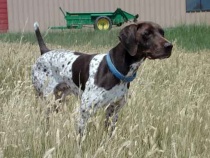
Nice looking dog, John. Nice style. I have GSPs too.
John Redmon
I can take the same dogs in the woods, and they will "nail" the birds right. They can pick up the scent in the fescue, but they can't pinpoint the exact location. Like I say, it may take two or three relocations to get them...they are not crowding. I don't want to be relocating an in-experienced dog a whole lot...
The thick fescue really messes with their confidence, and I don't want to give them any training pressure when their confidence is not sky high. This is some awfully thick fescue!
I'm thinking of bush-hogging the cover strips fairly narrow, like six to ten feet...
If I knew of a mixture of Round-up that will kill fescue, but will leave most of the native grasses, that would be helpful too. Meanwhile, I'm looking for better cover...
Nice looking dog, John. Nice style. I have GSPs too.
John Redmon
-
Wagonmaster
- GDF Junkie
- Posts: 3372
- Joined: Thu Jun 16, 2005 10:22 am
- Location: Minneapolis, MN
thanks. he thinks he is pretty.
sometimes if the cover is really dense and quite high, the scent just gets trapped down there. would be nothing wrong with cutting the strips more narrowly, and it might help by sort of venting them, that is, making them thin enough that the breeze can get through there.
if your set up is the same as mine, it is just yardwork. not so important that they learn to search here, that can be done elsewhere, on the real thing. what is important, is that they get good clean opportunities, so they can handle them well in training.
are you just hand planting those birds in the cover, or are you using some kind of release trap. sometimes the release traps can sure hold the scent in, and sometimes too, they have other smells to them like your hands and old bird turds, and the dog can react differently than to a clean bird by itself, especially a wild one. when i see that happening, i take the release out of it, I dizzy the birds instead and plant them without a release trap.
sometimes if the cover is really dense and quite high, the scent just gets trapped down there. would be nothing wrong with cutting the strips more narrowly, and it might help by sort of venting them, that is, making them thin enough that the breeze can get through there.
if your set up is the same as mine, it is just yardwork. not so important that they learn to search here, that can be done elsewhere, on the real thing. what is important, is that they get good clean opportunities, so they can handle them well in training.
are you just hand planting those birds in the cover, or are you using some kind of release trap. sometimes the release traps can sure hold the scent in, and sometimes too, they have other smells to them like your hands and old bird turds, and the dog can react differently than to a clean bird by itself, especially a wild one. when i see that happening, i take the release out of it, I dizzy the birds instead and plant them without a release trap.